
Working With Nature: Nature-Based Solutions for Maine’s Changing Shorelines
Across Maine, communities and coastal property owners are turning toward living shorelines and nature-based solutions to protect our waterways and critical land and infrastructure from erosion. A high-profile example of this work is currently taking shape at Willard Beach in South Portland, serving as a blueprint for how nature-based engineering can protect both public land and critical community infrastructure.
Spotlight on South Portland: The Willard Beach Demonstration Project
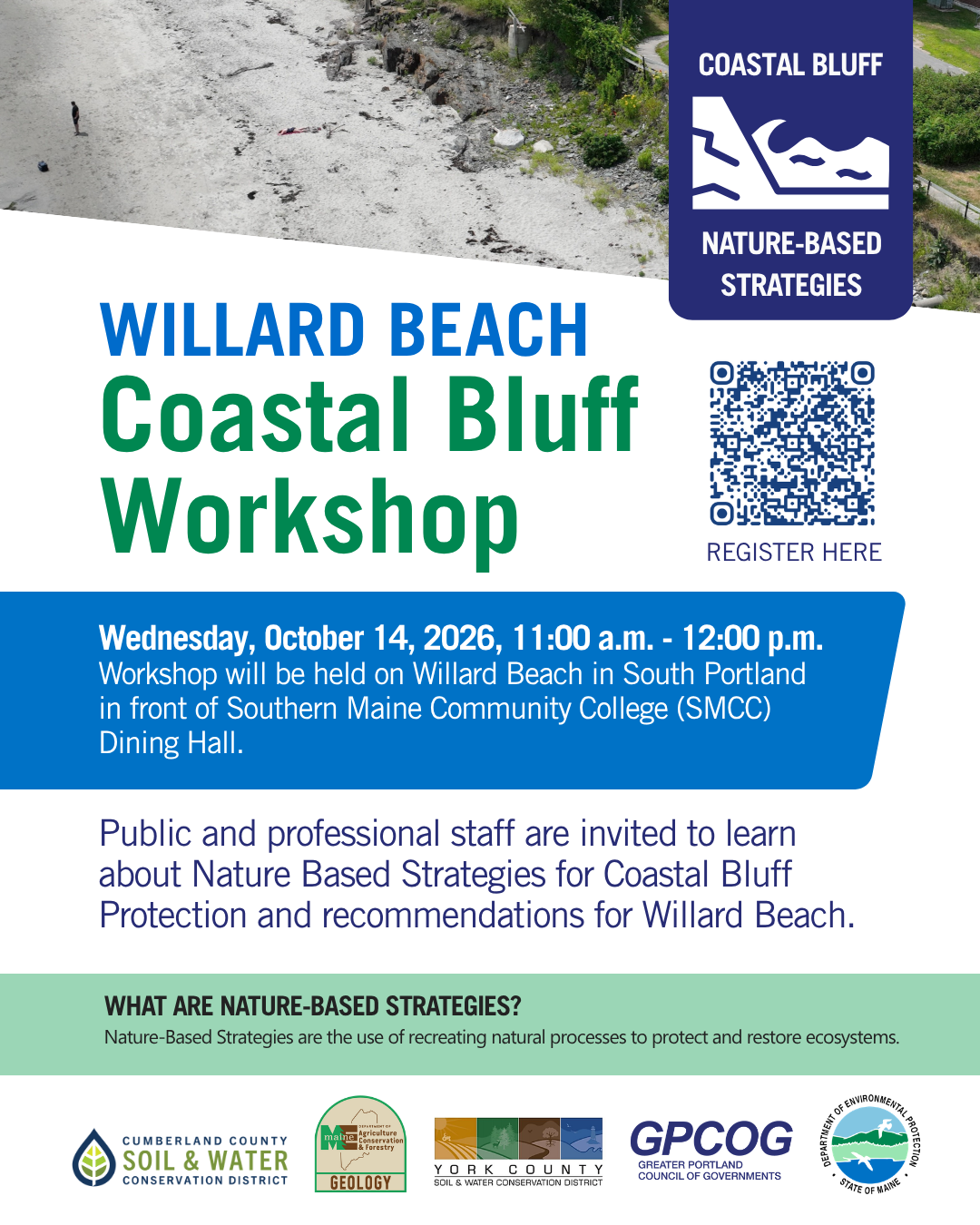
Steps away from Southern Maine Community College (SMCC) and a municipal sewage pump house, back-to-back winter storms battered the coastline, eroding fragile bluffs and forcing the closure of a popular walking path.
To protect the site without smothering the beach under rigid granite seawalls—which often reflect wave energy downward and scoop out sand—the Greater Portland Council of Governments (GPCOG) is using federal grants to develop a $800,000 to $1 million hybrid solution:
Sloped Bluff Reshaping: Relocating the closed walking path a few hundred feet inland behind the campus science building creates room to replace the steep, failing bank with a gentler sloped bluff that dissipates wave energy.
Heavy Vegetated Riprap: Embedded stone paired with deep-rooted native plants binds the slope while allowing nature to take over structural stabilization over time.
Engineered Sand Dune: Anchored with coir logs and native vegetation, a reconstructed dune system at the base provides a buffer without encroaching on the sandy public beach.
"Rocks don't have roots. Plants have roots, deep roots that can help stabilize from the top of the bluff to the dunes to the beach... Over time, plants will take over and do a lot of our work for us."
— Nathan Robbins, Climate Change Specialist, Maine Department of Environmental Protection
Why Vegetated Buffers & Living Shorelines Matter
Whether managing a coastal bluff on Casco Bay or an inland lakefront lot, establishing vegetative buffers creates a multi-layered defense system:
Root Stabilization: Deep, interlocking root systems from native trees, shrubs, and perennial grasses hold soil in place far more effectively than turf lawn or unanchored stone.
Runoff & Water Quality Protection: Multi-tiered vegetation slows storm runoff, filtering out sediment and excess nutrients before they reach Maine’s lakes and ocean waters.
Energy Dissipation: Sloped, plant-anchored banks absorb wave impact rather than deflecting forces onto neighboring properties.
Habitat Resilience: Native buffer plantings provide essential wildlife corridors and naturally thrive in local soil conditions without requiring synthetic fertilizers or pesticides.
Key Takeaways for Shoreline Projects
Acknowledge High-Energy Dynamics: High-impact coastal environments often require a hybrid approach. Pairing structural elements (like stone or coir logs) with deep-rooted native plants provides immediate stability while vegetation establishes over two to three growing seasons.
Plant in Multi-Tiered Layers: Combine canopy trees, mid-height shrubs, and native groundcovers or dune grasses to build a dense, living root network.
Plan for Long-Term Adaptation: As state scientists and geologists note, living shorelines help slow erosion and build resilience, giving communities the crucial time needed to adapt to long-term climate trends.
Learn More & Get Involved
Projects like Willard Beach demonstrate how nature-based practices protect infrastructure while preserving the ecology and beauty of Maine's shorelines.
For technical assistance, native plant guidance, or site consultation resources, explore our Water Protection & Conservation Programs or contact the Cumberland County Soil & Water Conservation District team today.